

Cerebellar ataxia affects balance, coordination, speech, and everyday movement and for most families, the hardest part isn’t just the symptoms themselves, it’s not knowing what’s actually causing them. Getting that underlying cause identified properly is really the first step toward any meaningful treatment plan. At Vaidya Healthcare Ayurveda, Kerala, patients receive supportive Ayurvedic care alongside physiotherapy, occupational therapy, speech therapy, and yoga therapy, all built around the individual’s specific condition rather than a one-size-fits-all protocol.
Book a Cerebellar Ataxia Consultation
What Is Cerebellar Ataxia?
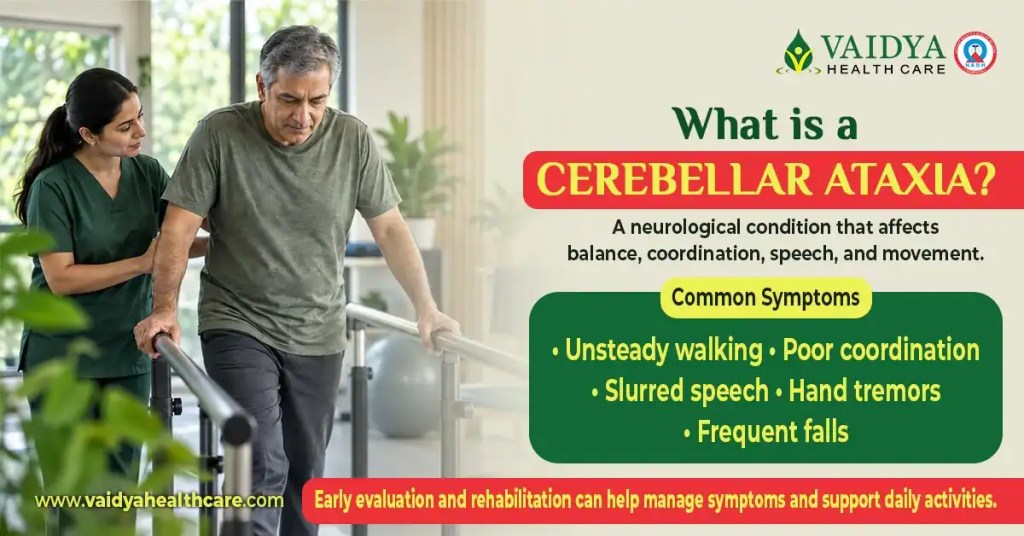
Cerebellar ataxia affects the cerebellum the part of the brain responsible for balance and coordination. When this area, or the nerve pathways connecting it, isn’t working properly, it can make walking, speaking, holding objects, and handling everyday tasks genuinely difficult.
It doesn’t always show up the same way. Some cases develop suddenly, others build gradually over months or years, and some are hereditary from the start.
Is Cerebellar Ataxia a Disease?
Not exactly. Cerebellar ataxia is usually a group of symptoms caused by an underlying condition affecting the cerebellum or its connected pathways. Proper evaluation is what identifies that underlying cause, and everything else treatment, rehabilitation, outlook depends on getting that part right.
Common Symptoms of Cerebellar Ataxia
Symptoms vary from person to person, but a few patterns show up consistently:
Unsteady walking
Frequent falls
Difficulty maintaining balance
Poor hand coordination
Slurred or slow speech
Tremors during movement
Difficulty writing or holding objects
Abnormal eye movements
Difficulty swallowing
Reduced ability to manage daily activities independently
What Causes Cerebellar Ataxia?
Hereditary Causes
Some forms of ataxia run in families, including spinocerebellar ataxia, Friedreich ataxia, and a handful of other inherited neurological conditions.
Acquired Causes
Others develop later in life, often linked to a stroke, head injury, vitamin deficiency, multiple sclerosis, an infection, an autoimmune condition, long-term alcohol-related damage, or as a side effect of certain medications.
Degenerative Causes
In some cases, the cerebellum gradually deteriorates over time this includes cerebellar degeneration, multiple system atrophy, and cases where no clear cause is ever identified, known as idiopathic cerebellar ataxia.
How Is Cerebellar Ataxia Diagnosed?
Diagnosis typically draws on several sources of information together, rather than any single test:
Medical and family history
Neurological examination
Balance and walking assessment
MRI or CT scan
Blood tests
Vitamin and metabolic testing
Autoimmune testing
Genetic testing, where relevant
Speech and swallowing assessment
If you’re coming in for an evaluation, it genuinely helps to bring along previous medical reports, scans, prescriptions, and test results this saves time and gives the doctor a clearer starting picture.
Can Cerebellar Ataxia Be Treated?
Treatment depends heavily on the underlying cause, current symptoms, disease stage, and functional ability. Some causes respond well to medical treatment. Others particularly hereditary or degenerative forms tend to need long-term rehabilitation and ongoing supportive care rather than a single fix.
Ayurvedic Treatment for Cerebellar Ataxia
At Vaidya Healthcare Ayurveda, treatment planning starts with a proper assessment covering the patient’s current symptoms, how long the condition has been present, walking and balance ability, muscle strength, digestion and sleep patterns, existing medical conditions, current medications, and how daily activities are being affected.
Ayurvedic Therapies That May Be Recommended
Depending on what the assessment shows, therapies considered may include:
Abhyanga
Shirodhara
Pizhichil
Njavarakizhi
Nasya
Basti
Internal Ayurvedic medicines
Diet and lifestyle guidance
Which of these actually gets recommended, and in what combination, depends entirely on the patient’s condition and clinical assessment not every therapy suits every case.
Cerebellar Ataxia Rehabilitation
Physiotherapy for Cerebellar Ataxia
Physiotherapy generally focuses on balance training, gait training, muscle strengthening, posture correction, coordination exercises, and fall-prevention work all aimed at making movement safer and more reliable over time.
Occupational Therapy
This covers hand coordination exercises, support with dressing and bathing, writing and gripping activities, daily-living training, and guidance on making the home environment safer.
Speech and Swallowing Therapy
For patients dealing with speech or swallowing difficulties, this includes speech clarity exercises, voice and breathing coordination, a proper swallowing assessment, safe eating techniques, and broader communication support.
Yoga and Breathing Practices
Modified yoga and breathing practices, tailored to what the patient can actually manage, may support mobility, relaxation, posture, and general well being alongside the other therapies.
Who May Benefit From Cerebellar Ataxia Rehabilitation?
Rehabilitation tends to help a fairly wide range of patients, including:
People with walking and balance difficulties
Patients recovering from a cerebellar stroke
People with hereditary ataxia
Patients experiencing speech or swallowing difficulties
Anyone needing assistance with daily activities
Patients requiring long-term neurological rehabilitation
Families looking for supervised inpatient care
Cerebellar Ataxia Treatment and Rehabilitation Goals
Realistic goals matter here, and treatment generally works toward supporting safer walking, improving balance and coordination, maintaining muscle strength, improving hand function, supporting speech and communication, reducing fall risk, improving performance in daily activities, building confidence and independence, and guiding family members and caregivers along the way.
Inpatient Cerebellar Ataxia Treatment in Kerala
The inpatient programme at Vaidya Healthcare Ayurveda typically includes an initial doctor consultation, individual treatment planning, Ayurvedic therapies, physiotherapy sessions, occupational therapy, speech and swallowing therapy where needed, yoga therapy, diet guidance, periodic progress assessment, and clear home-care instructions before discharge.
Why Choose Vaidya Healthcare Ayurveda?
Vaidya Healthcare Ayurveda is an Ayurvedic hospital in Kerala with experience in neurological rehabilitation, built around individual patient assessment rather than standardised treatment. This includes Ayurveda and rehabilitation support working together, physiotherapy facilities, occupational therapy support, speech therapy support, yoga and lifestyle guidance, inpatient treatment facilities, and ongoing education for both patients and caregivers.
Cerebellar Ataxia Treatment Cost in Kerala
Cost varies quite a bit depending on the type and cause of ataxia, symptom severity, whether care is inpatient or outpatient, treatment duration, which therapies are required, room category, how often physiotherapy is needed, and whether speech or occupational therapy is part of the plan.
Share Your Medical Reports for an Initial Assessment
What to Bring for Your First Consultation
Having the right documents on hand makes the first consultation far more productive:
MRI or CT scan reports
Neurologist consultation records
Blood test reports
Genetic test reports
Current medication list
Previous rehabilitation records
Hospital discharge summaries
Details of any falls, speech problems, or swallowing difficulties
Frequently Asked Questions
What is cerebellar ataxia?
Cerebellar ataxia is a neurological condition that affects balance, movement coordination, speech, and hand control, due to problems involving the cerebellum.
What are the early symptoms of cerebellar ataxia?
Early symptoms often include unsteady walking, frequent stumbling, poor hand coordination, slurred speech, and difficulty maintaining balance.
Is cerebellar ataxia curable?
It depends entirely on the underlying cause. Some causes improve with appropriate medical care, while hereditary or degenerative conditions generally need long-term rehabilitation and ongoing symptom management rather than a cure.
Can Ayurveda help with cerebellar ataxia?
Ayurvedic therapies may be included as supportive care alongside rehabilitation, depending on the diagnosis, symptoms, and overall health of the patient.
Is physiotherapy helpful for cerebellar ataxia?
Yes, physiotherapy can help improve balance strategies, walking ability, muscle strength, posture, and coordination over time.
How long does cerebellar ataxia rehabilitation take?
Duration depends on the cause, severity, current mobility level, treatment goals, and how the patient responds to rehabilitation — there’s no fixed timeline that fits everyone.
Is spinocerebellar ataxia hereditary?
Many types of spinocerebellar ataxia are inherited. Genetic consultation and testing are often recommended when there’s a family history involved.
Does Vaidya Healthcare provide inpatient care for cerebellar ataxia?
Yes, Vaidya Healthcare Ayurveda may provide inpatient Ayurvedic care and neurological rehabilitation based on a patient’s medical evaluation and specific treatment needs.
Consult Vaidya Healthcare Ayurveda for Cerebellar Ataxia Care
If you or a family member is dealing with balance problems, walking difficulty, or coordination issues that need proper evaluation, getting assessed early makes a real difference in how treatment unfolds.
Consult Vaidya Healthcare Ayurveda for Cerebellar Ataxia Care
If you or a family member is dealing with balance problems, walking difficulty, or coordination issues that need proper evaluation, getting assessed early makes a real difference in how treatment unfolds.
- Call now to speak with our specialist team or share your MRI/CT scan and medical reports for a preliminary assessment.
- Book an Appointment for Cerebellar Ataxia Assessment at Vaidya Healthcare Ayurveda, Kerala, and take the first step toward a clearer diagnosis and a personalised care plan.
Authored by Dr. Kiran B
Testimonials
Abdullah Nasser,OMAN
I am a professional foot ball Referee. suffered an Anterior cruciate ligament injury at the right knee. Doctors from Oman recommended for surgery. I decided to try alternative medicines and came to Vaidya. I underwent ayurvedic treatments and physiotherapy for one month and got great relief in the swelling and range of movements.
Keep readingRakesh, Bangalore
I came here with discomfort in the mind and mentally not pleasant. Today I am leaving this place with peaceful mind and healthy body. Thank you. I will visit again.
Keep reading


